If you have a dock on Sisters Cove Court, you already know the water looks wrong this year. What you might not know is why a summer with two separate five-inch rain months still left the lake sitting well under where it should be.
The easy explanation is drought. That's true, but it's not the interesting part. The interesting part is that Lake Norman got real rain this year and mostly kept falling behind anyway, and the reason has less to do with clouds than with what's underneath your yard.
The lake stopped listening to the rain
According to Duke Energy's own numbers, reported by Cornelius Today in early August, Lake Norman hovered around 95 feet for most of this summer, roughly 3.5 feet below its seasonal target. That's not a one-month dip. May brought about 5 inches of rain and the lake nudged up. Then June delivered only 2 inches, July came back with another 5, and by the first week of August the region had logged roughly 2 more. On paper, three of those four months were wet. On the lake, the level barely moved.
Brett Hartis, a water resources manager for Duke Energy, explained the mismatch to Cornelius Today in blunt terms: "It took a long time to get into this level of drought, and it will take a long time to get out of it." The mechanism he described is the part most residents haven't heard. The ground itself is so dried out from nearly two years of below-normal rainfall, stretching back to Hurricane Helene in October 2024, that a lot of the rain that falls now soaks straight into depleted soil instead of running off into creeks and eventually the reservoir. Roughly 70 percent of the months since Helene have brought less than half their normal rainfall. A five-inch month doesn't refill a lake when much of that water never makes it past the topsoil.
That's the part worth sitting with if you're used to checking the sky and assuming your dock will recover on its own schedule. This isn't a lake waiting for one good storm. It's a watershed that has to rebuild its groundwater first, and Duke's Low Inflow Protocol, put in place after the historic 2007-2009 drought, keeps conservation rules tightening as long as reservoir storage and stream flows stay low, regardless of how a single month's rain totals look. Lake Norman and its downstream neighbor, Mountain Island Lake, supply drinking water to more than 2 million people across the Catawba-Wateree basin, Charlotte and Cornelius included, so Duke manages releases for that first. Recreational flow, the water that keeps docks and coves usable, comes second.
Why a cove shape works against you
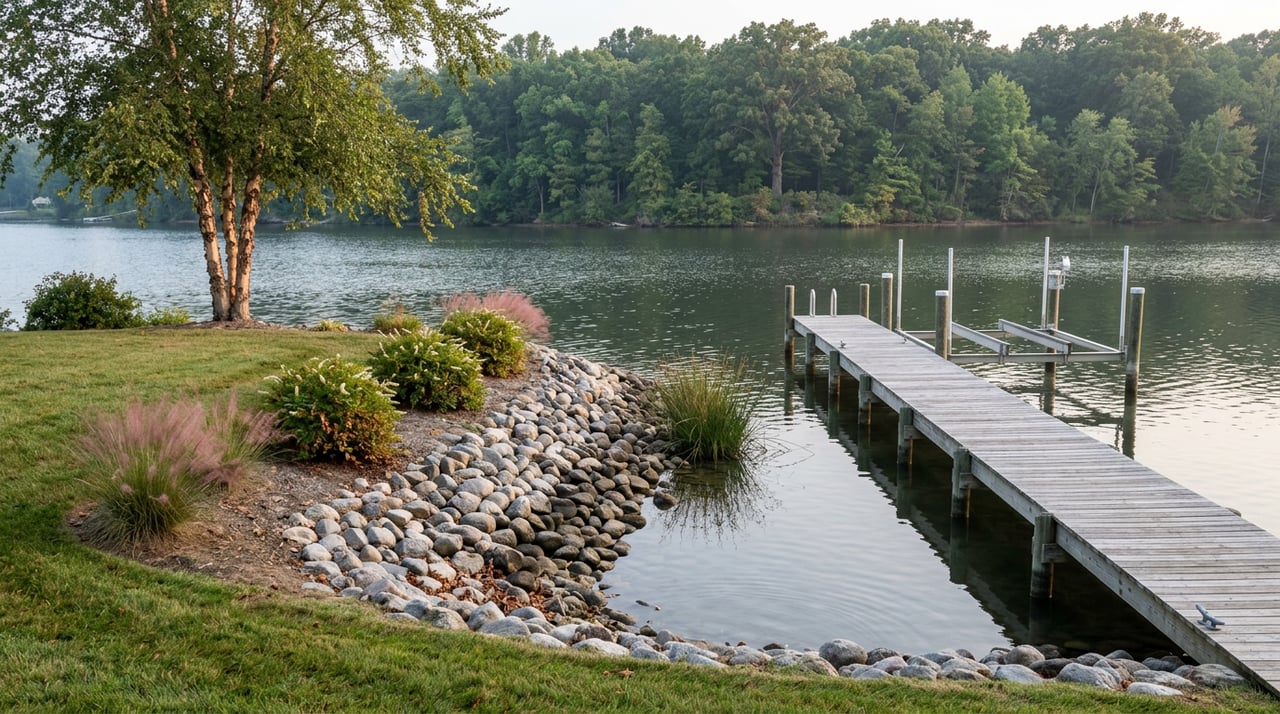
Here's the part that's specific to where you live. Sisters Cove sits on a finger of water that wraps around three sides of the neighborhood, which is exactly the geography that suffers first and most visibly when a lake runs low.
Open channel water and cove water do not lose depth at the same rate. A cove that holds six feet at full pond can shrink to two or three feet well before the main channel shows much change, because cove bottoms slope gradually and the stumps, rock, and rip-rap left over from when the reservoir was first flooded sit closer to the surface with every inch the lake drops. That's the same shallow-water hazard pattern boating instructors describe across Lake Norman's smaller inlets, and it applies directly to the kind of enclosed cove that gives this neighborhood its name and its calm-water feel most of the year.
The tradeoff that makes Sisters Cove appealing in June, protected water, less boat wake, a quieter shoreline, is the same tradeoff that makes it more sensitive in a year like this one.
What actually changes on the water
Duke Energy issued a Stage 1 drought advisory back in April. By August, conditions had moved to Stage 2, and stream flows measured over a six-month average make it unlikely the region drops back down anytime soon. That escalation happened quietly, in the middle of a summer that still delivered real rain twice. It's worth knowing where things stand, because the practical effects show up on the water before they show up in a headline.
Spectrum News reported in late April that Duke Energy estimated Lake Norman was three feet shallower than the same week the year before, and that some public ramps had already closed because the water no longer reached the end of the concrete. Submerged stumps and rocks that are normally invisible were sitting close enough to the surface to catch a lower unit or a prop.
Keegan Higgins, who owns 77 Watersports, put the adjustment in practical terms for boaters heading out onto skinny water: "If you think 50 yards is safe, double it. Make it 100 yards." That's the kind of guidance worth keeping in mind whether you're launching from a public ramp or idling out of a private dock on the cove, since submerged hazards don't care which kind of slip you started from.
A few things worth checking before you head out this fall:
- If you trailer a boat rather than keep it on a private dock, confirm the ramp you use most often is still deep enough to launch from. Several of the shallower public ramps around the lake have become difficult to use as levels dropped through the summer.
- Give shoal markers more room than you would in a normal year. The advice from 77 Watersports, doubling your clearance, applies anywhere the bottom has been climbing all season.
- If your dock floats, watch for uneven settling where part of the structure touches bottom while the rest still floats. That kind of imbalance stresses the frame gradually, and it's easy to miss until something starts to rack.
As of this week, the gauge at Lake Norman read 96.02 feet, about three-quarters of a foot higher than it was seven days earlier, a small recovery worth noting even if it still sits well under Duke's full-pond benchmark of 100 feet. Progress, but slow progress, which is consistent with what Hartis described. The last drought this size, in 2007 and 2008, took about a year of Stage 3 restrictions before a wetter summer and an active hurricane season finally turned it around. Nobody's saying this one runs that long, but nobody's promising a quick fix either.
The season is going ahead anyway
None of this is stopping the fall calendar on the water. The Lake Norman Yacht Club, just up the shoreline on Yacht Road in Mooresville, still has its Flying Scot fleet racing this season, with the ACC Fall 48 regatta set for November 7 and 8. Lake Norman Community Sailing has its members-only Flying Finale Regatta scheduled for October 25, a $20-a-head afternoon of food and closeout racing before the season winds down. Sailboats draw less water than most powerboats and tend to race in the open channel rather than tucked-away coves, which is part of why low water hasn't touched the racing schedule the way it's touched ramp access and dock clearance elsewhere on the lake.
If you're planning to get out on the water from Sisters Cove this fall, that's the actual shape of the season. The lake is recovering, slowly, from a drought that started with soil rather than sky, your cove is more exposed to that recovery lag than the open channel is, and the local sailing calendar is running as scheduled regardless. Knowing which of those three things applies to your specific plans is more useful than just knowing the word "drought."
If you're weighing what any of this means for a property on the water, whether it's dock depth, shoreline access, or how a home like this holds up across a season like this one, Zach Francis has spent years working this stretch of Lake Norman and is glad to talk through what he's seeing firsthand. Let's Connect.